
Trigger Warning
- Unfiltered technical opinions.
- Brutal honesty.
- WordPress plugins held accountable.
OK, so, once again we find ourselves in the land of infinite possibilities – and infinite insecurities – called WordPress. A place where anyone, anywhere, at any time can release a plugin that alters the behavior of millions of websites… with no review, no audit, and no accountability.
It’s like giving every freshman in a programming 101 class access to the cockpit of a commercial airliner. What could go wrong?
_“But my plugin works fine!” – Someone silly, right before getting hacked._
The Illusion of Safety
You install a plugin. It adds a shiny feature. You get a dopamine hit. The site works. You move on.
No warnings. No tests. No threat models. No _proof_ it won’t take down your entire database the next time someone sneezes near your contact form.
WordPress, bless its democratized heart, is an open barn door. Anyone can walk in. And, frequently, something nasty does.
You see the problem here, don’t you?
Let’s Talk About the Real Villains
No, it’s not the hackers. They’re just playing the game. It’s not even the core WordPress team – they’re overworked, underfunded, and trying to rewrite Gutenberg for the third time this month.
The real villains?
Developers who ship code to 50,000 websites and have never done a formal security audit.
“Oh but it’s just a settings page.” Cool. So was the form that took down Equifax.
“Oh it’s only for admins.” Great, until someone finds a way to impersonate an admin.
“Oh it’s not public.” Famous last words. Then the GET parameter injection shows up, and suddenly ?user=1&role=admin gives me a dashboard with God mode.
Philosophical Interlude: What Is “Secure Code”?
You think it’s about escaping inputs, don’t you?
You think it’s about CSRF nonces and prepared SQL statements.
You’re not wrong. But you’re not nearly right enough.
Secure code isn’t a checklist. It’s a worldview.
It’s building like you expect to be attacked.
It’s assuming your plugin will be used on a site with 47 other plugins, 3 page builders, and one rogue AI-generated shortcode that spits out raw JavaScript inside an iframe. Welcome to reality.
It’s not about whether _you_ trust your own code. It’s whether I trust it after I’ve pentested it at 3AM on a caffeine bender.
Code Interlude
`` if ( isset( $_GET['user'] ) ) { $user = $_GET['user']; echo "Welcome back, $user!"; } ``
Classic.
- No sanitization.
- No escaping.
- No user validation.
It’s like setting up a kissing booth in a biohazard lab. Bold. Stupid. Infectious.
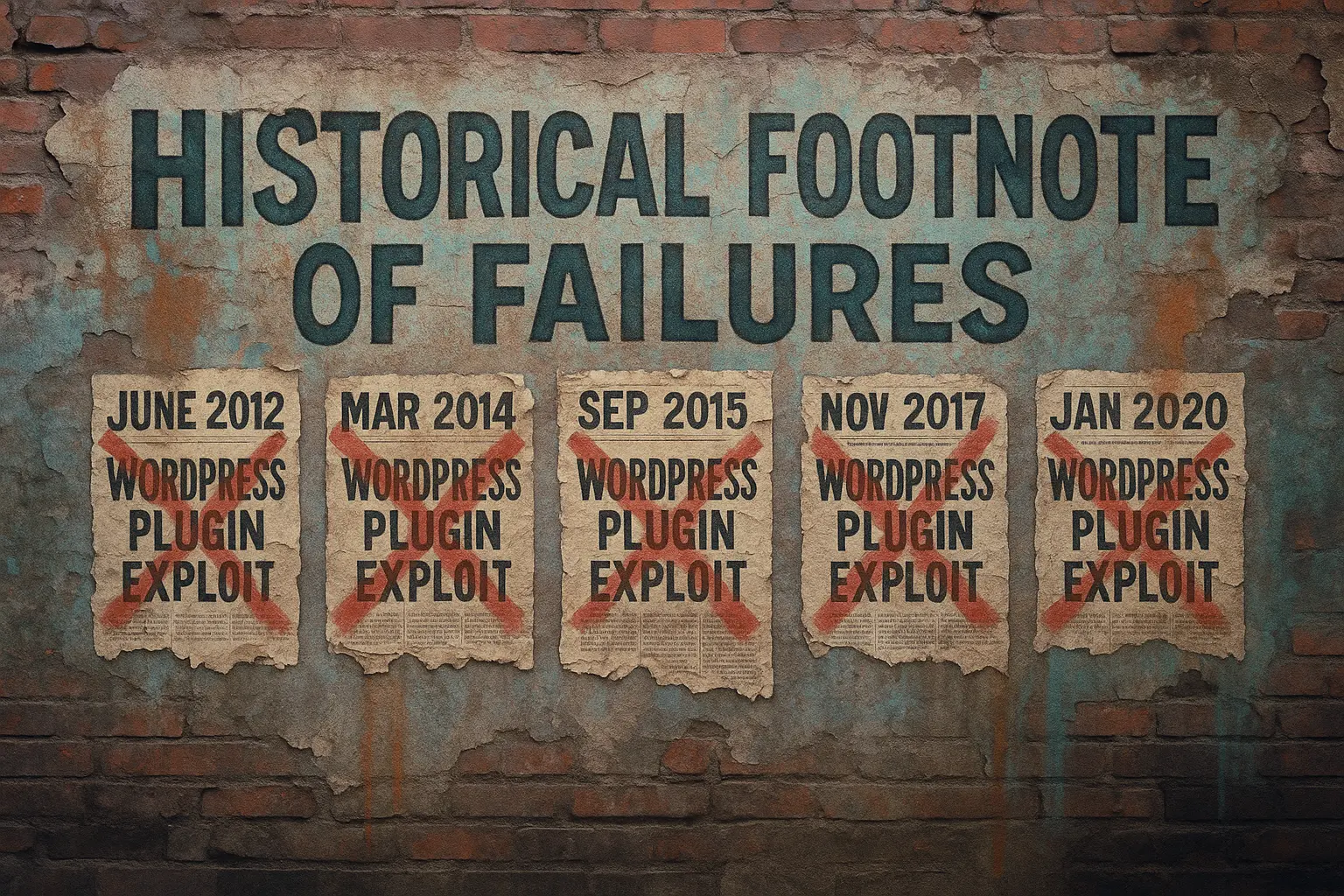
A Historical Footnote of Failures
Let’s not pretend this is new.
The WordPress plugin ecosystem has always been a dumpster fire of good intentions and tragic implementations.
First they added admin-ajax.php, then they opened it to the world, then they forgot to check capabilities, then someone realized you could brute force actions by just guessing the action parameter. Beautiful.
Then came REST API abuse. Then privilege escalation. Then SSRF through image uploads because someone thought wp_remote_get() was safe. (Spoiler: it isn’t.)
So, yes, we’ve been here before. And we’ll be here again. Unless…
You Get Audited
That’s it. That’s the punchline. You get your code audited.
Not by your buddy. Not by an intern. Not by running wp_scan and calling it a day.
By someone who lives in this world. Someone who understands both how WordPress works – and how it breaks.
Someone who can spot that add_action( 'wp_ajax_nopriv_do_something', ... ) is an open invitation to attackers when you forgot to validate the input.
Someone like me.
Lesson Learned
There’s no such thing as a small plugin. Only small minds who think their plugin couldn’t possibly be dangerous.
If you’re shipping code to thousands of installs, you’re responsible for every ounce of risk it introduces.
TEST. It’s a verb. Starts with a T. Ends with “your code might not get owned this week.”
Get your code audited. Or keep rolling the dice.
Just don’t be surprised when someone like me finds your vuln before you do.
Because I’m looking. Professionally.
Want your plugin reviewed like your reputation depends on it?
It does.
Contact me. Let’s lock it down.